
About
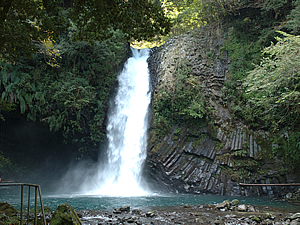 Joren Falls cascading 25 meters into its cobalt blue basin. Photo: Wikimedia Commons
Joren Falls (浄蓮の滝, Jōren-no-taki) stands as one of the Izu Peninsula's most iconic natural attractions, recognized as one of Japan's Top 100 Waterfalls by the Ministry of the Environment in 1990. 🔗 This designation, backed by the Japanese Ministry of the Environment and Forestry Agency, was compiled from 517 waterfalls identified across Japan. 🔗
Located in the Yugashima district of Izu city, Shizuoka Prefecture, in the upper reaches of the Kano River, the waterfall cascades 25 meters high and 7 meters wide from dramatic basalt cliffs. 🔗 The falls is also designated as a Shizuoka Prefectural Natural Monument. 🔗
The straight waterfall creates a beautiful cobalt blue basin at its base, with a plunge pool measuring approximately 15 meters deep. 🔗 This stunning visual combination of white cascading water against dark volcanic rock and vibrant blue water has captivated visitors for centuries.
Cultural & Literary Significance
Beyond Physical Beauty: Cultural Importance
Joren Falls' cultural significance extends far beyond its scenic beauty. Before a path was cleared during the Meiji Era, the falls were enveloped by dense forest, creating a mysterious and awe-inspiring atmosphere that captured the imagination of artists and writers. 🔗
The falls' cultural value is significantly amplified by its association with the famous enka song "Amagi-goe" (天城越え) by Sayuri Ishikawa. This dramatic portrayal of passionate love and sorrow set in the Amagi mountains specifically references the falls and its spider legend, cementing Joren Falls in the national consciousness as a pilgrimage site for fans of the song. A stone monument dedicated to the song stands near the falls as testament to this connection. 🔗
Connection to "The Izu Dancer"
Joren Falls is inextricably linked to Nobel laureate Yasunari Kawabata's seminal 1926 short story, "The Izu Dancer" (伊豆の踊子, Izu no Odoriko). 🔗 While the waterfall itself is not explicitly mentioned in the narrative, it serves as a key landmark along the "Odoriko Hodō" (踊子歩道) - the walking path that traces the journey of the story's protagonist and the troupe of traveling performers. 🔗
Kawabata (1899-1972) became the first Japanese writer to win the Nobel Prize for Literature in 1968. 🔗 The story is a cornerstone of modern Japanese literature, capturing a sense of youthful longing, nostalgia, and the transient beauty of human connection against the backdrop of the Izu landscape. 🔗
For Japanese readers, visiting Joren Falls is part of a larger literary pilgrimage - an act of physically inhabiting the world of the novel. Statues of the protagonist and the dancer near the waterfall's entrance serve as a powerful visual anchor to this beloved story, making the site a touchstone for Japan's literary heritage. 🔗
The Jorōgumo Legend: Spiritual Significance
The primary spiritual and folkloric significance of Joren Falls is the legend of the Jorōgumo (女郎蜘蛛) - a spider yōkai (spirit-monster) that can shapeshift into a beautiful woman. 🔗
According to folklore, the legend tells of a man who, after dropping his tool into the waterfall basin, is ensnared by the threads of the Jorōgumo disguised as a woman. She makes him promise never to reveal her existence. He keeps the promise, but his melancholy leads him to waste away. When a priest attempts to save the village from the spirit, he is defeated by the spider's power. 🔗
The legend serves as a cautionary tale and imbues the waterfall with a sense of danger and sacred power - a place where the human and spirit worlds intersect. 🔗 The name "Joren Falls" itself is said to derive from a temple named Joren-ji that once stood nearby, indicating a history of Buddhist reverence for the site. 🔗
Geological & Environmental Significance
Volcanic Formation & Izu Peninsula Geopark
Joren Falls is registered as a Geosite within the Izu Peninsula UNESCO Global Geopark. 🔗 The continuous volcanic geological history of the area is unique in the world, and nowhere else is it possible to trace the numerous and dramatic changes of volcanism for such an extended period. 🔗
The waterfall formed approximately 17,000 years ago when lava flowed from the Hachikuboyama Volcano (a "parasitic volcano" neighboring Mt. Amagi) and cooled. 🔗 🔗 The rock surface displays distinctive columnar cracks (columnar joints) that formed as the basalt cooled, creating dramatic hexagonal patterns. 🔗
The basalt underneath the waterfall came from a lava flow sourced by the eruption of Mt. Hachikubo, and these geological features are clearly visible on the rock faces surrounding the falls. 🔗
Rare Fern Species
The area is home to the rare Haikomochishida fern (also called Joren-shida), which grows on the rock faces near the waterfall. 🔗 This endemic species adds to the ecological significance of the site.
Wasabi Cultivation Heritage
A World Agricultural Heritage System
The area surrounding Joren Falls is renowned for wasabi cultivation, a practice deeply embedded in Japanese food culture. The clear, cool, and nutrient-rich water flowing from the Amagi mountains provides the perfect environment for growing high-quality sawa-wasabi (water-grown wasabi). 🔗
The traditional cultivation method used here, known as Tatamiishi (畳石式), is recognized as a Globally Important Agricultural Heritage System by the Food and Agriculture Organization of the United Nations (certified in 2018). 🔗
Historical Development
The Izu region in the Mt. Amagi range is considered the origin of wasabi cultivation worldwide, which began in the Utogi district of Shizuoka approximately 400 years ago during the Keicho era (1596-1615). 🔗 In 1744, Kanshiro Itagaki, who served as the guardian of Mt. Amagi, passed on the harvesting methods from Utogi to the Izu area, marking the start of Izu's wasabi production. 🔗
In 1892, the revolutionary Tatamiishi Style was developed by a stonemason in the Izu region. This method utilizes a layered construction for wasabi fields: a deep foundation is dug into the ground and filled with large stones, followed by pebbles, and finally fine sand for surface soil. 🔗 By using the abundance of clear flowing streams to water the fields, farmers filter out impurities and maintain constant water temperature while simultaneously supplying nutrients and oxygen to the plants, ensuring consistency of their wasabi yields. 🔗
Culinary Significance
The resulting wasabi is prized for its clean, sharp heat and complex, fragrant aroma, which is considered essential for authentic sushi, sashimi, and soba. Visitors can see the iconic, stepped wasabi fields right by the waterfall basin, offering a direct view into a vital aspect of Japanese gastronomy. 🔗
Visiting Information
Access & Transportation
From Shuzenji Station: Take the bus bound for Kawazu Station (38-minute ride), then walk 10 minutes from Joren Falls bus stop. 🔗
Parking: Free parking is available at the falls. 🔗 🔗
Operating Hours: The falls are accessible during daylight hours year-round. There is no nighttime illumination. 🔗 In November, sunset occurs around 4:30 PM, so plan visits accordingly. 🔗
Admission: Free 🔗
Physical Requirements: Visitors must descend approximately 190 steps from the parking area to reach the viewing area. 🔗 The path is well-paved and stepped but can be challenging on the return climb. 🔗 The descent and return require moderate fitness. 🔗
Duration: A typical visit lasts 60-90 minutes, allowing time to descend, view the falls, explore the surrounding area including wasabi fields, and ascend back. 🔗 Some visitors report 30 minutes is sufficient for the basic experience. 🔗
Special Restrictions: Drones are explicitly prohibited. 🔗 Climbing on rocks or entering the water is forbidden for safety and preservation reasons. 🔗
Facilities
Joren Falls Tourism Center: Located in the parking area, this facility features a gift shop and restaurant with a Showa retro atmosphere. 🔗 The center sells products centered on specialty wasabi along with traditional tourist souvenirs. 🔗
Wasabi Shop: At the bottom of the stairs near the falls is a wasabi farm and shop selling fresh wasabi and wasabi products. 🔗 The famous wasabi soft-serve ice cream is available and described as "yummy and refreshing." 🔗
Fishing Facilities: A fishing shop provides fishing rods and bait for a small fee, where visitors can catch rainbow trout and amago. 🔗 Grilled fish from daily catches is also available for purchase. 🔗
Dog-Friendly: The location is dog-friendly, with many visitors bringing their pets. 🔗
The Odoriko Trail
Trail Overview
The full Odoriko Trail (踊子歩道) follows the old Shimoda Highway, beginning near Joren Falls and crossing Amagi Pass before descending alongside the Kawazu River. 🔗 The trail is approximately 19 kilometers long through uneven terrain and mountain paths. 🔗
Starting from Joren Falls
The trail begins at the Joren no Taki bus stop, accessible via a 35-minute bus ride from Shuzenji Station. 🔗 After leaving Joren Falls, hikers pass through the Old Amagi Tunnel and then hike along the mountain streams of the Kawazu River past literary monuments dedicated to "The Dancing Girl of Izu." 🔗
Trail Characteristics
Difficulty: The Joren Falls to Taro Sugi section is considered moderate, with an elevation gain of 1,049 feet, taking approximately 3-3.5 hours to complete. 🔗
Trail Conditions: This is described as an easy and well-marked course with good signage - basically a long walk through very lush vegetation. 🔗
Literary Connection: You can pick up the 3km Amagi Hiking Trail from the falls to the village of Yugashima Onsen, experiencing the landscape that inspired Kawabata's masterwork. 🔗
November Seasonal Considerations
Autumn Foliage
November is considered one of the best times to visit Joren Falls. 🔗 The peak of autumn colors (kōyō) typically occurs from mid-November to early December in this region. 🔗 The area around the falls is adorned with vibrant reds, oranges, and yellows of maple and keyaki trees, creating a stunning contrast with the dark basalt rock and white water. 🔗
For the broader Eastern Japan region (which includes Shizuoka), red leaves typically peak from early November to early December in the mountains and late November to mid-December in the plains. 🔗 Yellow leaves peak around mid-November to mid-December. 🔗
Weather & Water Flow
Temperature: November temperatures in the area are expected to be 12-16°C with approximately 93mm precipitation. Layered clothing and a warm jacket are advisable. 🔗
Water Flow: Water flow is generally stable and plentiful year-round due to the geology of the Amagi mountains. 🔗
Practical Visiting Tips
The Recommended Visit Approach
The Descent: The approach involves descending about 190 steps, which is seen as a transition from the everyday world into a cooler, more mystical space. The air temperature drops noticeably as you get closer to the basin. 🔗
Appreciate the Details: Beyond the main cascade, visitors are encouraged to notice the columnar jointing of the basalt rock, the rare Haikomochishida fern growing on rock faces, and the exceptional clarity of the water. 🔗
Culinary Experience: A visit is incomplete without sampling the local wasabi. Trying wasabi-flavored soft-serve ice cream is a popular, almost ritualistic activity. For a deeper experience, visiting a local restaurant for fresh wasabi grated over a bowl of rice (wasabi-don) is highly recommended. 🔗
Visitor Reviews & Tips
Cooling Effect: In summer, the falls treat visitors to thin, cooling sprays of water, making it a refreshing stop. 🔗
Wasabi Experience: Visitors consistently highlight the wasabi ice cream as a must-try experience, describing it as both unique and refreshing. 🔗
Fresh Fish: Be sure to sample the fresh grilled fish caught at the falls - both rainbow trout and amago are available. 🔗
Physical Accessibility: While the path is well-maintained, the steep stairs can be challenging for older visitors or those with mobility limitations. 🔗
Value: Free parking and admission make this an economical tourist spot. 🔗
Location: View on Google Maps
Source: attractions/izu-peninsula/joren-falls.md