
About
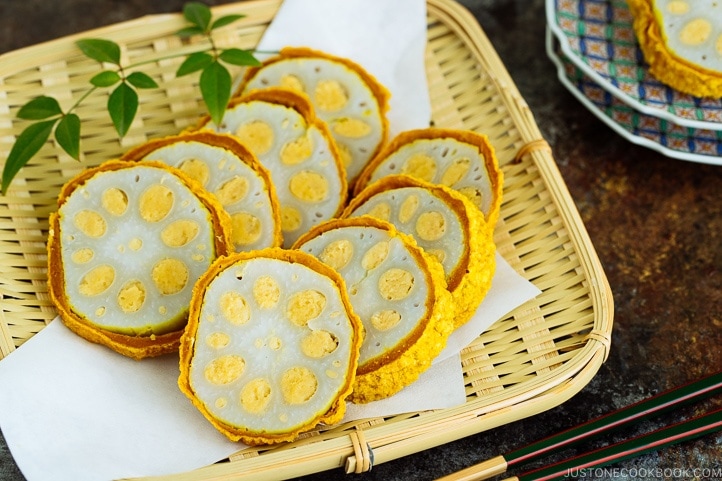 Sliced karashi renkon showing the characteristic yellow batter and lotus root cross-section pattern. Photo from Just One Cookbook.
Karashi renkon is a traditional Kumamoto specialty with nearly 400 years of history, dating back to the Kannei Era of the Edo Period. 🔗 The dish consists of boiled lotus root stuffed with a mixture of barley miso and Japanese karashi (hot mustard), coated in a vibrant yellow batter made from egg, flour, and natural pigments such as turmeric and gardenia, then deep-fried until crispy. 🔗
This culinary specialty is recognized as one of Japan's 100 Best Local Dishes by the Ministry of Agriculture, Forestry, and Fisheries, standing alongside basashi as Kumamoto's signature dish. 🔗
Cultural & Historical Significance
Origins in the Edo Period
In 1632, Tadatoshi Hosokawa, the first lord of the Hosokawa clan ruling Kumamoto, suffered from chronic illness and weakness. Concerned for his health, a monk named Gentaku (also known as Kazuhisa) from Rakanji Temple (Rahanzan Temple) painstakingly searched for nutritious foods that might restore the lord's vigor. The monk created karashi renkon, and Tadatoshi ate it regularly, eventually regaining his health. 🔗
The dish held special cultural significance because the lotus root's cross-section echoed the Hosokawa family crest, making it particularly auspicious. Until the Meiji Restoration, the recipe remained a strictly guarded palace secret. 🔗 This exclusivity is why karashi renkon is still made only in Kumamoto Prefecture today.
After the Meiji era, the recipe spread among commoners, and improved transportation carried it nationwide. Today, karashi renkon stands beside basashi as a culinary emblem of Kumamoto. 🔗 It is an indispensable part of Osechi dishes during New Year celebrations and is regularly featured on izakaya menus throughout the prefecture. 🔗
Visiting Information
Where to Find Authentic Karashi Renkon
Mori Karashi Renkon (森からし蓮根) - Main Store
This is the "ganso" (originator) bearing the title of creator, making the shop a living monument to one of Kumamoto's most inventive foods. 🔗
- Address: 2-12-32 Shinmachi, Chuo-ku, Kumamoto City, Kumamoto 860-0004
- Phone: 096-351-0001
- Website: https://www.karashirenkon.co.jp/
- Access: 1-minute walk from Shinmachi stop on Kumamoto City Tram B Line 🔗
- Hours: 9:00 AM - 7:00 PM daily
- Price Range: Under ¥1,000
- Specialization: Handmade karashi renkon using high-quality ingredients, characterized by crispy texture and exquisite spiciness 🔗
- Location: View on Google Maps
Murakami Karashi Renkon Ten (村上からし蓮根店)
This business has been serving some of Kumamoto's best karashi renkon for over 50 years. 🔗
- Address: 3-5-1 Shinmachi, Chuo-ku, Kumamoto City
- Phone: 096-353-6795
- Website: https://murakami-karashirenkon.jp/
- Hours: 8:30 AM - 5:00 PM
- Closed: Saturdays and days before public holidays
- Price Range: Under ¥1,000
- Special Offerings:
- Karashi Renkon Croquette (¥110)
- Karashi Renkon Burger (¥300)
- Imo Manju (¥110) 🔗
- Workshop Experience: Karashi renkon-making workshops available Sunday-Friday, ¥1,300 per person (minimum 2 participants), requires 1-day advance reservation 🔗
- Location: View on Google Maps
Regional Cuisine Aoyagi (郷土料理 青柳)
A long-established Japanese restaurant founded in 1949 serving luxurious Kumamoto specialties. 🔗
- Address: 1-2-10 Shimotori, Chuo Ward, Kumamoto City
- Phone: 096-353-0311
- Access: 2-minute walk from Shiyakusho-mae tram stop
- Lunch Hours: 11:30 AM - 2:30 PM (Last Order 1:30 PM)
- Dinner Hours: 5:00 PM - 10:00 PM (Last Order 9:00 PM)
- Closed: Irregular holidays
- Capacity: 210 seats with private tatami rooms
- Menu: Karashi renkon alongside basashi, Ichimoji Kurukuru, and Amakusa seafood 🔗
- Location: View on Google Maps
Additional Shopping Locations
Sakura no Baba Josaien (near Kumamoto Castle)
- Shopping and dining complex with specialty food shops selling karashi renkon as a souvenir
- Mori Karashi Renkon has a branch location here 🔗
Higo Yokamon Market (Kumamoto Station)
- Perfect for last-minute souvenir shopping before departing Kumamoto
- Multiple vendors selling packaged karashi renkon 🔗
Kumamoto Airport
- "Asora Gate Shop" and "Asora Lobby Shop"
- Packaged karashi renkon available for travel gifts 🔗
The Culinary Experience
Flavor Profile & Texture
Karashi renkon delivers a distinctive sensory experience combining multiple textures and flavors. The exterior batter is crispy and golden from deep-frying, while the lotus root itself provides a crunchy, fibrous texture. 🔗 The mustard-miso filling offers a complex flavor: the sharp, pungent heat of Japanese karashi mustard balanced by the sweetness of white miso and sugar, creating what reviewers describe as "addictive" with its exquisite spiciness. 🔗
The turmeric batter adds subtle earthy notes and gives the dish its characteristic yellow color, which is said to resemble gold and contribute to its auspicious symbolism. When freshly fried, the contrast between the crispy outside and fluffy inside creates the perfect texture for this regional specialty. 🔗
Traditional Preparation
The preparation process is intricate and time-intensive. First, lotus root is boiled, then each hole is carefully stuffed with the karashi-miso mixture made from soy pulp (okara) or Japanese breadcrumbs (panko), seasoned with karashi mustard, miso, and sweetener. After stuffing, the lotus root must rest in the refrigerator overnight (at least 6 hours). 🔗 The next day, it's dunked in the turmeric batter and deep-fried until crisp. This labor-intensive process is why handmade versions from specialty shops are particularly prized.
How to Eat Properly - CRITICAL INFORMATION
NEVER bite directly into a whole piece of karashi renkon. This is the most important etiquette rule for first-time eaters. The dish contains copious amounts of intensely spicy karashi mustard, which is normally used in very small quantities. 🔗
Proper Method:
-
Always slice before eating: Cut the karashi renkon into 5-8mm thick rounds (about ⅓ inch). This thickness allows the mustard to be distributed across multiple bites and reveals the attractive lotus root pattern resembling the Hosokawa family crest. 🔗
-
Standard serving: Eat the sliced rounds as is, or with soy sauce or mayonnaise if you prefer a milder experience. 🔗
-
Traditional pairing: Karashi renkon is most commonly enjoyed as an appetizer with sake, shochu, or beer. It's one of the most popular snacks to accompany Japanese alcohol. 🔗
-
Alternative serving: Can also be eaten as a side dish with rice for everyday meals or included in bento lunch boxes. 🔗
-
Modern variation: Some enjoy karashi renkon placed between bread like a sandwich. 🔗
Practical Visiting Tips
November Visit Considerations
Optimal Season: Karashi renkon is best relished during the cooler months of autumn and winter when lotus roots are particularly nutritious. November is an excellent time to enjoy this specialty, as lotus roots are at their peak nutritional quality during autumn. 🔗
Current Availability: All specialty shops operate year-round. Freshly fried versions are available daily at dedicated shops, while packaged versions suitable for souvenirs are available at markets, shopping arcades, and the airport. 🔗
Crowd Levels: Specialty shops like Mori Karashi Renkon and Murakami Karashi Renkon Ten can be busy during lunch hours (11:30 AM - 1:30 PM) and early evening. For a more relaxed purchasing experience, visit mid-morning (9:30-11:00 AM) or mid-afternoon (2:30-4:00 PM).
Practical Considerations
Portion Sizes: A typical serving consists of one lotus root cut into 6-10 slices, priced under ¥1,000. This makes an excellent appetizer for 2-3 people or a generous solo portion with drinks. 🔗
Takeaway & Storage: Most specialty shops offer packaged versions suitable for travel. Freshly fried karashi renkon is best consumed within 2-3 hours. Vacuum-sealed packages have longer shelf life and make excellent souvenirs, though they should be consumed within the expiration date printed on the package. 🔗
Spice Tolerance: Be aware that Japanese karashi mustard is significantly spicier than Western yellow mustard. If you're sensitive to spicy foods, start with a small piece and have drinks readily available. Many restaurants offer soy sauce or mayonnaise as condiments to moderate the heat. 🔗
For International Visitors
Language: Most specialty shops have minimal English, but pointing and gestures work well. Saying "karashi renkon kudasai" (please give me karashi renkon) is sufficient. Many shops display photo menus and pre-packaged options. 🔗
Dining Strategy: If trying karashi renkon for the first time, consider visiting Regional Cuisine Aoyagi where it's served as part of a multi-course meal with other Kumamoto specialties. This provides context and allows you to experience it alongside complementary dishes. For a more casual experience, visit Mori Karashi Renkon or Murakami Karashi Renkon Ten for takeaway and enjoy with local beer from a convenience store. 🔗
Workshop Experience: The karashi renkon-making workshop at Murakami Karashi Renkon Ten (¥1,300, available Sunday-Friday with advance reservation) provides hands-on cultural insight into the preparation process and makes for a memorable activity. 🔗
Money-Saving Tips
- Budget Option: Purchase from specialty shops rather than restaurants - significantly cheaper and equally authentic
- Souvenir Strategy: Buy packaged versions at Higo Yokamon Market (Kumamoto Station) rather than the airport for better prices
- Sampling: Some shops in Sakura no Baba Josaien offer small sample pieces before purchase
Photo Opportunities
The vibrant yellow color and distinctive lotus root cross-section pattern make karashi renkon highly photogenic. Best photo moments:
- Sliced presentation: Capture the golden batter and geometric lotus root pattern
- Shop fronts: Traditional specialty shops with Japanese signage make excellent cultural photos
- Pairing shots: Photograph with local sake or beer to show traditional serving context
Cultural Etiquette
- Say "itadakimasu" before eating if dining in a restaurant
- Use chopsticks to pick up individual slices
- If dining with locals, wait for them to demonstrate proper eating method
- It's acceptable to ask for additional condiments (soy sauce, mayonnaise) if the spice is too intense
- Compliment the shop owner with "oishii desu" (it's delicious) - much appreciated at small specialty shops 🔗
Nearby Attractions & Integration
Complementary Experiences in the Area
Shinmachi/Shimotori Shopping District: Both Mori Karashi Renkon and Murakami Karashi Renkon Ten are located in the Shinmachi area, within walking distance of:
- Kamitori/Shimotori Shopping Arcades (covered shopping streets)
- Kumamoto Castle (15-minute walk)
- Suizenji Jojuen Garden (short tram ride)
- Regional Cuisine Aoyagi restaurant 🔗
Recommended Route: Visit Kumamoto Castle in the morning, stop at Sakura no Baba Josaien for lunch and karashi renkon sampling, then explore Kamitori/Shimotori shopping arcades in the afternoon. Purchase freshly made karashi renkon from Mori or Murakami shops to enjoy with evening drinks at your accommodation.
Pairing with Other Kumamoto Specialties
Karashi renkon is traditionally enjoyed alongside:
- Basashi (horse meat sashimi): Kumamoto's other signature specialty
- Local sake or shochu: The spicy-sweet flavor pairs excellently with Japanese alcohol
- Taipien (noodle soup): Another Kumamoto original, providing contrast to the fried texture
- Ikinari Dango: Sweet potato dessert to balance the savory-spicy flavors 🔗
Important Notes
Current Status
- All recommended shops are currently operating (as of October 2025)
- Murakami Karashi Renkon Ten closed Saturdays and days before public holidays
- Regional Cuisine Aoyagi has irregular holidays - call ahead to confirm 🔗
Dietary Considerations
- Contains: Lotus root, miso (soy-based), karashi mustard, wheat flour (batter), eggs
- Allergen warnings: Soy, wheat, egg
- Not suitable for: Those with severe spice intolerance, soy allergies, or egg allergies
- Vegetarian-friendly: Yes, though traditionally paired with meat dishes 🔗
Recognition & Awards
- Designated as one of Japan's "100 Best Local Dishes in Agriculture, Mountains, and Fishing Villages" by the Ministry of Agriculture, Forestry, and Fisheries 🔗
- Essential component of New Year's Osechi cuisine in Kumamoto
- Protected cultural food heritage specific to Kumamoto Prefecture
Location: View on Google Maps (Mori Karashi Renkon main store)
Source: attractions/kumamoto/karashi-renkon.md